Void Observatories: Mapping the Cosmic Fringe
From the lunar far side to the edge of the heliosphere, our reach into the dark is defined by the tools we build to witness it.
Echoes of the Impact
The lunar far side has long been a place of conjecture, shielded from Earth’s view and largely untouched by human hands. The Chang'E-6 mission changed this, returning nearly two kilograms of soil from the South Pole-Aitken basin. This site, the deepest and oldest impact basin on the Moon, offers a rare window into the lunar crust and mantle. Analysis reveals a complex, bimodal grain distribution and a composition rich in aluminum and calcium, yet notably distinct from the KREEP-rich terranes sampled by previous missions. These fragments of basalt and breccia are not merely geological curiosities; they are markers of a volcanic history that has remained locked away, waiting for a mechanical hand to retrieve it.
The soil returned from the far side is a mixture of local basalt and ancient ejecta, holding the secrets of the lunar mantle.
Instruments in the Dark
Exploration is an act of translation, turning the invisible physics of space into data we can parse. In 1968, the OGO-5 satellite carried instruments designed to map the plasma properties of the Earth's environment. By measuring electrostatic and electromagnetic fluctuations, these sensors provided the first empirical evidence of the bow shock, where the solar wind slams into our magnetic field. Decades later, our methods have matured, yet the fundamental requirement remains: we must place our sensors precisely where the phenomena occur, whether that is the high-energy X-ray emissions of the XRISM mission or the wide-field ultraviolet mapping proposed for the ASTRA Initiative.
The View from the Station
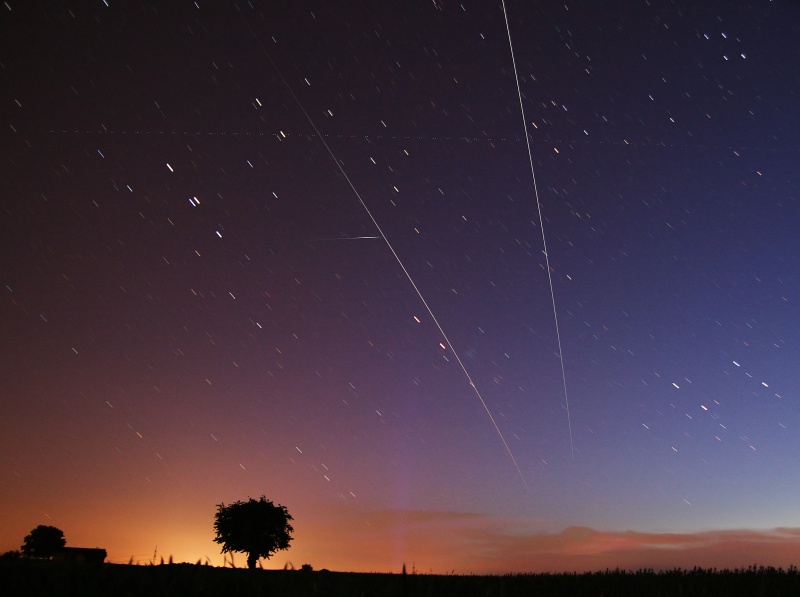
Human presence in orbit is a study in both endurance and perspective. Astronauts like Jessica Meir, whose background in comparative physiology—studying the high-altitude flight of geese and the deep-sea dives of penguins—informs her work in the extreme environment of space, represent the bridge between biological limits and mechanical capability. When she and her colleagues operate the Canadarm2 or conduct spacewalks, they are performing maintenance on the very infrastructure that allows us to persist in a vacuum. This work is often captured from the ground, where long-exposure photography reveals the ISS and its visiting shuttles as fleeting, luminous arcs against the backdrop of the stars.
Human exploration is a study in endurance, where the physiological lessons of the Earth are applied to the vacuum of orbit.
Surveying the Infinite
As our reach extends, so does our capacity to observe the distant universe. The China Space Station Telescope, slated for launch in 2026, promises to increase our catalog of galaxy-galaxy strong lenses by three orders of magnitude. By utilizing the gravitational distortion of light, we can map the distribution of matter across the cosmos with unprecedented precision. This is the natural evolution of the work begun by the 19th-century Leviathan of Parsontown, now replaced by multispectral composites from space-based observatories that reveal the multimillion-degree gas surrounding distant spiral galaxies.
The Final Coast
Not all missions are designed for return. Some, like the Dawn spacecraft or the long-lived Pioneer 10, are destined to become permanent residents of the solar system or beyond. Dawn’s final days, spent orbiting the dwarf planet Ceres to map the salty residues of its Occator crater, serve as a quiet conclusion to an eleven-year journey. Pioneer 10, meanwhile, continues its silent drift into interstellar space, a human artifact now six billion miles away. These machines, eventually silenced by the exhaustion of their power supplies, remain our most enduring ambassadors, coasting through the void long after their active service has ended.
These machines remain our most enduring ambassadors, coasting through the void long after their active service has ended.