Cosmic Measurement and Celestial Origins
From the precise mapping of our own planet to the chemical signatures of distant star-forming clouds, our reach into the cosmos remains tethered to the rigors of measurement.
The Cartographer of Orbits
When the mid-twentieth century demanded a transition from regional surveying to a global enterprise, the work of Irene Fischer became a quiet pillar of the space age. A mathematician and geodesist who fled Nazi-occupied Vienna, Fischer found herself at the Army Map Service, tasked with refining the very shape of the Earth. Her calculations regarding the Earth's oblateness and the lunar parallax were not merely academic exercises; they were essential navigation tools for the Mercury and Apollo programs. When her findings initially clashed with the established literature, she was barred from using them. It was only when the first satellites confirmed her figures that she was vindicated, leading her to quip that the satellites had not accepted the accepted literature either.
The satellites had not accepted the accepted literature, either.
Miniaturizing the Void
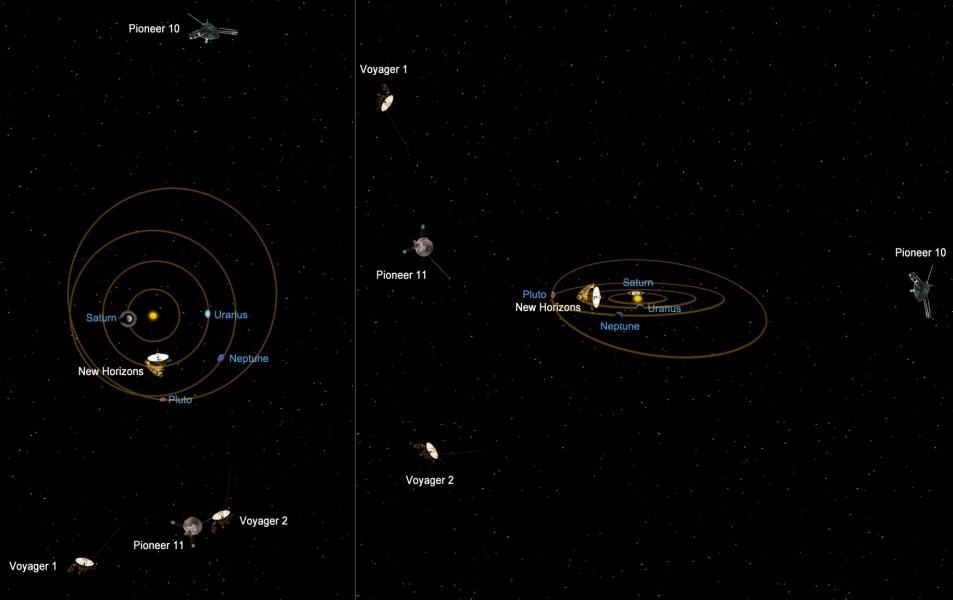
The mechanics of leaving our immediate neighborhood have evolved from the brute force of chemical rockets to the subtle potential of diffractive sails and autonomous constellations. While early missions like Voyager 1 and Pioneer 10 relied on gravity-assist maneuvers to fling themselves into the interstellar void, modern engineering focuses on miniaturization and efficiency. Today, the design of interplanetary transfers involves complex reachable sets, where sail-based propulsion allows for more nuanced trajectories. Meanwhile, the development of nano-satellites—weighing no more than 10 kilograms—promises a future of simultaneous, multi-point observations, reducing the cost and complexity of monitoring the Sun-Earth connection.
Relics and Rubble
Objects left in space often serve as unintended archives. The Lunokhod 1 rover, which traversed the lunar Sea of Rains in 1970, remains a functional instrument today; its retroreflectors allow researchers to bounce laser pulses off its frame to measure the Moon's orbit with millimeter precision. Similarly, the Stardust mission brought back cometary material that predates the solar system, providing a physical sample of the conditions that birthed our neighborhood. Even the debris of asteroids, such as the Didymos system, tells a story of fragmentation and reaccumulation, revealing that binary asteroids are often the result of spin-up and mass shedding rather than solitary formation.
Objects left in space often serve as unintended archives.
The Chemistry of Origins
As our observational tools grow more sensitive, the focus has shifted toward the chemical and structural origins of habitable environments. The James Webb Space Telescope has begun to inventory the icy ingredients of protostellar systems, identifying complex organic molecules in the Chamaeleon I cloud that suggest a water-rich environment for star formation. This search for the building blocks of life extends to the detection of rocky planets around binary stars, where algorithms like MARA allow us to parse microarcsecond astrometric data. Even at the edge of the observable universe, gravitational lensing allows us to glimpse individual stars like Earendel, pushing the boundaries of what we can resolve in the early, chaotic epochs of the cosmos.