Cosmic Inventory of Celestial Debris
From the ice-bound cradles of distant stars to the debris of our own neighborhood, we are cataloging the building blocks of the cosmos.
The Chemistry of Cold
In the dark, dense reaches of molecular clouds like Chamaeleon I, the ingredients for future worlds are assembled in silence. Recent observations from the James Webb Space Telescope have revealed that these frigid environments are far from inert. By analyzing the light filtering through these clouds, researchers have identified complex mixtures of water ice, methanol, and various hydrides. These ices act as a chemical reservoir, where surface reactions on dust grains slowly build the molecular foundations necessary for life.
This inventory is not uniform. While protostellar systems like Ced 110 IRS4 exhibit a rich diversity of species—including carbon dioxide, methane, and complex organic molecules—the specific chemical pathways remain a subject of intense scrutiny. Models suggest that the formation of methanol is dominated by the hydrogenation of carbon monoxide, a process that requires specific gas densities and timescales to reach the abundances observed. These icy grains are the quiet precursors to planetary systems, holding the chemical memory of the cloud from which they emerged.
These icy grains are the quiet precursors to planetary systems, holding the chemical memory of the cloud from which they emerged.
Fragments of a Violent Past
The architecture of our solar system is written in the debris left over from its formation. Small bodies, such as the binary asteroid system Didymos and its moonlet Dimorphos, serve as rubble piles—collections of fragments reassembled after the catastrophic destruction of larger parent bodies. The distribution of boulders on their surfaces suggests a history of fragmentation and mass shedding, where the spin of a primary body eventually casts off material to form a companion.
Even our own Moon serves as a repository for this history, though in a more literal sense. The Soviet Lunokhod 1 rover, abandoned on the lunar surface in 1971, has found a second life as a passive scientific instrument. By bouncing laser pulses off its original reflectors, researchers can track minute shifts in the Moon's orbit, using a relic of the early space age to refine our understanding of gravitational theories and lunar composition today.
The Mechanics of Reach
Exploration requires a delicate balance between the ambition of the mission and the constraints of physics. As we look toward the outer solar system and beyond, the reliance on massive, expensive launch vehicles is giving way to more nuanced approaches. Miniaturized satellites, weighing no more than 10 kilograms, are being designed to operate in constellations, providing simultaneous measurements of the Sun-Earth connection from multiple vantage points. These nano-satellites prioritize autonomy and radiation-hardened electronics to minimize operational costs while maximizing scientific return.
Similarly, the design of interplanetary transfers is evolving. New computational methods, such as those utilizing diffractive sails, allow for more precise navigation through the solar system. By calculating reachable sets under arbitrary dynamics, engineers can optimize trajectories for missions that require efficiency in both time and propellant. Whether through the cooling of infrared detectors to near absolute zero or the deployment of lightweight solar arrays, the goal remains the same: to extend our reach into the cold, distant dark.
The goal remains the same: to extend our reach into the cold, distant dark.
Looking Across the Abyss
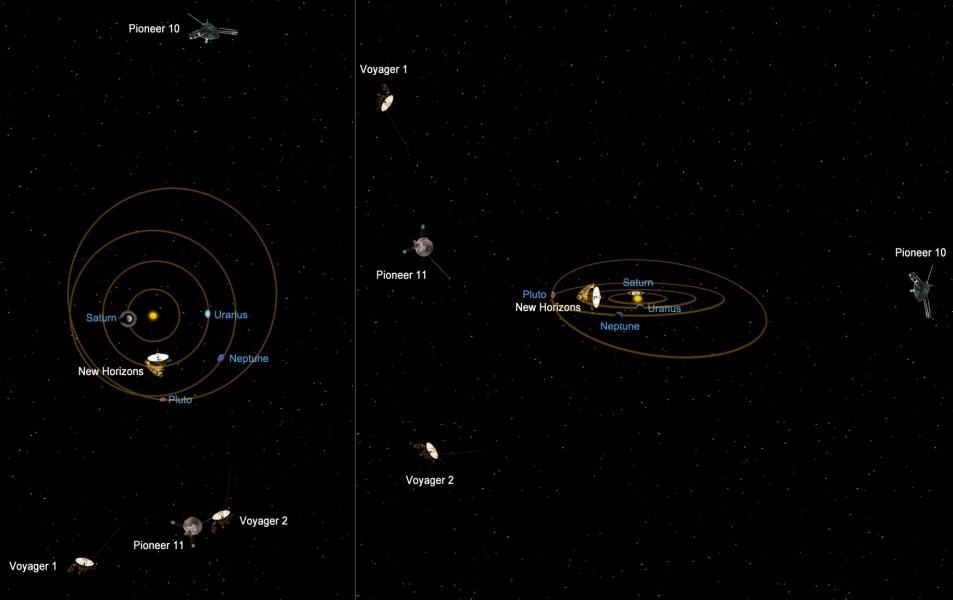
Humanity's gaze has stretched from the immediate vicinity of our own planet to the earliest epochs of the universe. Voyager 1, launched in 1977, now traverses the interstellar medium, a lonely scout carrying the legacy of a mid-century space race. Meanwhile, ground-based and space-based observatories work in tandem to identify the signatures of distant stars and planets. Gravitational lensing, which magnifies the light of ancient galaxies, has allowed us to glimpse individual stars like Earendel, existing at redshifts that place them in the infancy of the cosmos.
Closer to home, the search for habitable worlds around nearby binary stars has moved into the realm of microarcsecond astrometry. Algorithms like MARA are now being tuned to detect the subtle gravitational tug of rocky planets orbiting in the habitable zones of our stellar neighbors. From the physical artifacts of the Apollo missions—cameras modified to survive the harsh lunar glare—to the digital pipelines processing data from the next generation of telescopes, our methods of observation have become as sophisticated as the questions we ask. We are no longer just looking at the sky; we are beginning to map the demographics of the galaxy.