Signals from the Dark
From the chemical signatures of ancient stars to the detection of high-energy neutrinos, modern astronomy is redefining the limits of what we can know about the cosmos.
Beyond the Visible
The history of observational astronomy is a record of our expanding reach, moving from the naked eye to instruments that perceive the invisible. For centuries, the limit of human vision was the Andromeda Galaxy, a faint smudge 2.5 million light-years away. Today, we routinely map the chemical composition of stars in our own galactic halo and peer into the deep infrared to witness the formation of galaxies at the edge of the observable universe. This transition from passive observation to active, multi-messenger inquiry has fundamentally altered our understanding of the cosmos.
The history of observational astronomy is a record of our expanding reach, moving from the naked eye to instruments that perceive the invisible.
Mapping the Galactic Fossil Record
Modern surveys now allow us to categorize the constituents of our galaxy with unprecedented precision. By utilizing spectrophotometric data, researchers can identify extremely metal-poor stars that serve as fossils of the early universe. These stars, often associated with ancient accretion events, reveal the violent history of the Milky Way’s assembly. Similarly, the study of hierarchical triple star systems has been transformed by combining decades of archival data with new, high-cadence observations from space telescopes, allowing us to refine the orbital dynamics of systems that were once only glimpsed in passing.
The Turbulent Lives of Stars
While we map the stars, we also observe the chaotic processes of stellar evolution. High-resolution sub-millimeter observations of red supergiants like Betelgeuse reveal persistent, asymmetric structures in their inner atmospheres, likely driven by stable, large-scale convective cells. These observations challenge existing models of stellar mass loss and atmospheric stability. Simultaneously, the study of young protostellar disks shows that while large-scale asymmetries are common, the formation of distinct rings and gaps is a relatively rare feature in the earliest stages of evolution, suggesting a more complex timeline for planetary development than previously assumed.
High-resolution sub-millimeter observations reveal persistent, asymmetric structures in stellar atmospheres, challenging existing models of mass loss.
Probing the Distant Engines
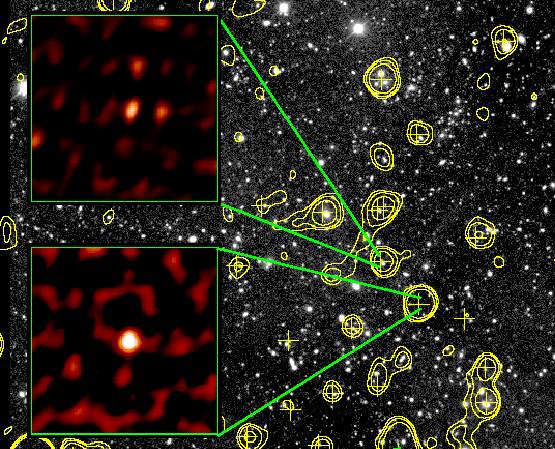
At the furthest reaches of space, we encounter galaxies that defy simple categorization. Some, like J1316+2614, exhibit extreme star-formation rates and leak significant amounts of ionizing radiation, providing a window into the conditions of the early universe. To study these distant objects, astronomers must rely on sophisticated techniques like Very Long Baseline Interferometry, which combines signals from multiple radio telescopes to achieve resolutions far exceeding those of single optical instruments. This allows us to resolve the central engines of distant galaxies, revealing the massive black holes that anchor them.
The Era of Multi-Messenger Synthesis
The future of the field lies in the synthesis of disparate data types. The detection of high-energy neutrinos associated with blazar flares marks a significant step toward multi-messenger astronomy, where light, particles, and gravitational waves are used in concert to decode cosmic events. As we refine our ability to detect these signals, we also remain open to the unexpected, such as transient phenomena that challenge standard physical frameworks. Whether through the systematic analysis of archival sky surveys or the deployment of next-generation detectors, the goal remains the same: to translate the faint, disparate signals of the universe into a coherent narrative of its physical reality.