Light Spectrum Dynamics in Space
By synthesizing light across the spectrum, astronomers are moving past simple snapshots to map the hidden dynamics of a restless universe.
Beyond the Visible
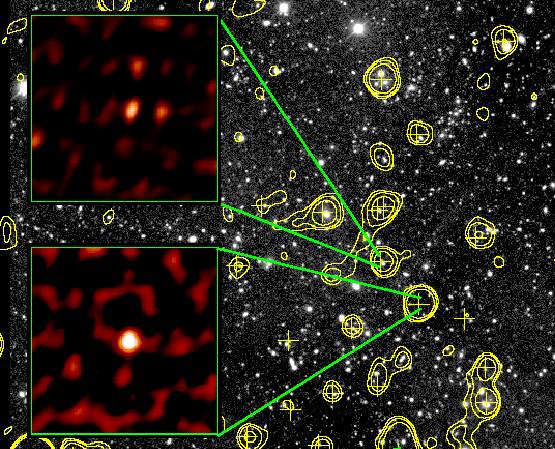
To observe the universe is to contend with the limitations of our own vantage point. For decades, the Hubble Deep Field served as our primary lens into the early cosmos, providing a static, visual record of distant galaxies. Yet, light is a spectrum, and visible wavelengths represent only a fraction of the information reaching us from the void. By shifting our gaze into the mid-infrared, as the MIRI Deep Imaging Survey has recently done, we gain access to the rest-frame near-infrared emission of galaxies at extreme redshifts. This allows us to peer through the veil of cosmic dust that obscures the inner workings of galactic evolution, revealing mature stellar populations and the energetic signatures of active galactic nuclei that were previously hidden in plain sight.
To observe the universe is to contend with the limitations of our own vantage point.
The Surface of the Unreachable
When we turn our instruments toward individual stars, the challenge shifts from distance to scale. Massive, evolved objects like the yellow hypergiant IRC +10420 or the red supergiant Betelgeuse are not merely points of light; they are complex, dynamic environments defined by intense mass loss and convective turbulence. Because these stars are physically too small to be resolved by conventional imaging, astronomers employ interferometry—combining signals from multiple telescopes to synthesize a larger aperture. This technique has mapped the asymmetric winds of hypergiants and the persistent, hot convective patches on the surface of Betelgeuse, proving that even the most stable-looking stars are in a constant state of internal flux.
Dynamics in the Dark
The architecture of star systems often defies simple classification. By tracking eclipse timing variations over decades—bridging the gap between the Kepler mission and the TESS era—researchers have identified hundreds of hierarchical triple-star systems, revealing the complex dynamical dance of objects bound by gravity. Similarly, the study of protostellar disks using ALMA’s sub-millimeter sensitivity shows that while many disks appear smooth, they are frequently characterized by subtle azimuthal asymmetries. These structures, often invisible to less precise instruments, are the precursors to planetary formation, suggesting that the early stages of solar systems are far more varied than a uniform model would imply.
The architecture of star systems often defies simple classification.
The Archaeology of Energy
The history of the cosmos is also written in the chemical and energetic debris that permeates space. By analyzing the metallicities of stars in the galactic halo, surveys like Pristine are effectively performing stellar archaeology, linking individual red giants to ancient, retrograde mergers that shaped the Milky Way. Meanwhile, the detection of high-energy neutrinos coincident with gamma-ray flares from distant blazars represents a new frontier in multi-messenger astronomy. These signals, arriving from across the universe, provide a rare, direct link between the most energetic events in the cosmos and the physical processes that govern the distribution of matter and energy on a galactic scale.