Invisible Light Patterns in Modern Astronomy
Modern astronomy no longer relies on the simple act of looking, but on the painstaking reconstruction of signals that the human eye was never meant to perceive.
The Persistence of the Signal
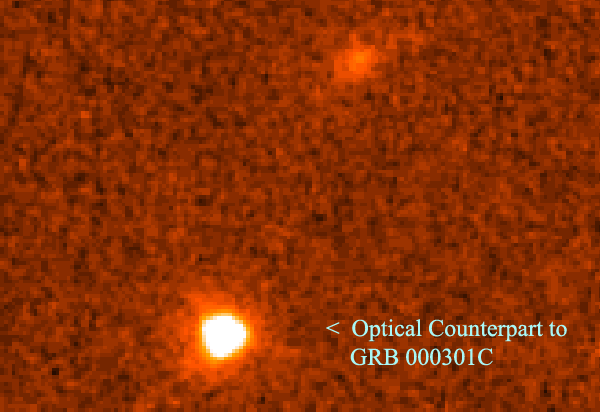
The history of observational astronomy is a transition from the snapshot to the long-exposure synthesis. When early gamma-ray bursts were first detected, the challenge was one of speed; instruments had to pivot in seconds to catch a fading optical counterpart. Today, the ambition has shifted toward the deep, static stare. The MIRI Deep Imaging Survey, for instance, utilized over 40 hours of integration time on a single filter to peer into the Hubble Ultra Deep Field. This is not a search for the fleeting, but a deliberate effort to resolve the faint, mature stellar populations of the early universe. By pushing into the mid-infrared, astronomers can now bypass the obscuring veils of dust that once rendered the most distant galaxies invisible to optical telescopes.
This evolution in sensitivity has changed how we define a discovery. Where once a single smudge on a photographic plate might have been hailed as a host galaxy, modern analysis demands a rigorous accounting of multi-wavelength data. The initial confusion surrounding the host of a gamma-ray burst—often mistaken for a foreground object—is now mitigated by the ability to cross-reference radio, infrared, and X-ray signatures. We have moved from a reliance on the serendipitous alignment of light to a systematic, multi-instrumental interrogation of the sky.
We are no longer merely observers of light; we are architects of the data that light leaves behind.
Discs and the Dust Between
The internal structure of galaxies remains a primary target for high-resolution study, particularly the transition from chaotic mergers to stable, rotating discs. Recent investigations into sub-millimetre galaxies reveal that these massive, star-forming systems are not always the violent, late-stage collisions once assumed. Instead, many exhibit the undisturbed, disc-like morphologies of their quieter counterparts. The apparent structural differences between these populations are often an illusion of perspective, caused by significant, structured dust content that reddens and obscures the near-infrared light.
This pattern of hidden complexity extends to the earliest stages of stellar birth. Within protostellar discs, the dust continuum serves as a map of mass distribution, yet it is rarely a simple one. While some systems display the clear gaps and rings associated with planet formation, many others appear smooth at current resolutions. The challenge for the observer is to distinguish between intrinsic physical structures and the radiative transfer effects that occur within optically thick regions. We are learning that the most informative features are often those that require us to look past the surface brightness to the underlying velocity and density fields.
The Surface of the Giant
Probing the atmospheres of individual stars requires a leap in resolution that standard imaging cannot provide. For stars like Betelgeuse or the yellow hypergiant IRC +10420, the photosphere is not a uniform sphere but a dynamic, clumpy environment. High-resolution sub-millimetre observations have revealed persistent, hotter patches on the surface of Betelgeuse, likely driven by convective cells that endure for years. These features suggest a level of stability in stellar convection that challenges existing models.
Interferometry allows us to resolve these environments on milliarcsecond scales, effectively turning multiple telescopes into a single, massive aperture. By analyzing the differential phases and visibilities across specific emission lines, researchers can map the inner wind regions and the extended dust shells of these dying stars. What appears as a point of light to the naked eye is revealed, through these techniques, to be a complex, asymmetric engine of mass loss, shedding material into the interstellar medium with a structure that is as intricate as it is unpredictable.
Tomography of the Invisible
When a phenomenon is too small or too distant to be imaged directly, astronomers turn to the indirect reconstruction of motion. In the case of the binary system IP Pegasi, the spiral pattern of its accretion disc cannot be seen by any telescope. Instead, it is mapped through doppler tomography—a spectroscopic technique that translates the velocity of hydrogen gas into a spatial map. By measuring how light is shifted as gas orbits the central white dwarf, researchers can reconstruct the trailing spiral arms with mathematical precision.
This reliance on indirect evidence is equally vital when investigating the nature of active galactic nuclei. When a candidate binary supermassive black hole system shows anomalous spectral lines, the task is to determine whether these signals represent two distinct cores or the complex, reddened emission of a single, active engine. By assembling a comprehensive spectral energy distribution from infrared to X-ray, astronomers can test these hypotheses against the data. The goal is to strip away the noise of variability and extinction to reveal the true geometry of the system, a process that is as much about statistical modeling as it is about the collection of photons.
The Limits of the Network
The future of observational astronomy lies in the creation of global networks that function as a single, coherent instrument. The next generation of gravitational-wave observatories, such as the Cosmic Explorer and the Einstein Telescope, will be orders of magnitude more sensitive than current detectors. This will allow for the localization of events far beyond the peak of star formation, providing a new window into the early universe and the growth of black holes through cosmic history. The ability to coordinate these detections with electromagnetic observations will be essential for identifying the counterparts to these gravitational signals.
As our sensitivity increases, so too does the need for a framework to interpret the unexpected. The identification of mysterious transients in archival sky surveys highlights the difficulty of distinguishing between known physical processes and the unknown. Whether these phenomena are eventually attributed to exotic physics like axion quark nuggets or simply to the limitations of historical data, the path forward remains the same: the rigorous application of new instruments to old mysteries. We are building a future where the entire sky is monitored, analyzed, and understood not through a single lens, but through the combined output of a planet-wide array.