Stellar Evolution and Universal Origins
From the violent collapse of massive cores to the quiet cooling of white dwarfs, the life cycles of stars define the material composition of the universe.
The Heavy Seeds of Early Light
The early universe holds a population of enigmatic, compact sources known as little red dots. Recent investigations suggest these may not be active galactic nuclei, but rather supermassive stars. These primordial objects, reaching up to one million solar masses, provide a compelling explanation for the rapid emergence of supermassive black holes. By modeling the spectra of metal-free stars, researchers have found that the distinct V-shaped Balmer break and emission features observed by the James Webb Space Telescope match the theoretical signatures of these massive progenitors. This hypothesis offers a self-consistent view of early stellar evolution, where the most massive stars exist only briefly before collapsing into the seeds of future galaxies.
The most massive stars exist only briefly before collapsing into the seeds of future galaxies.
The Anatomy of a Dying Sun
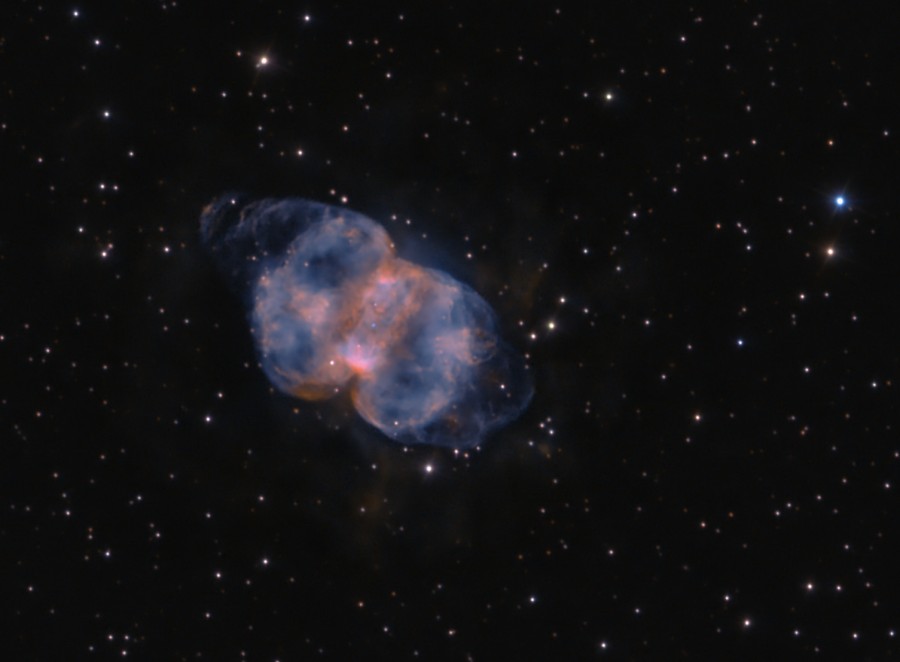
When a star like our own exhausts its nuclear fuel, it does not vanish in a cataclysmic explosion but instead sheds its outer layers to form a planetary nebula. Objects like Messier 76, the Little Dumbbell, reveal the complex geometry of this final act. Viewed nearly edge-on, the nebula appears as a box-like structure, though it is likely a donut-shaped shroud of gas cast off by a dying sun. The core that remains is a white dwarf, a dense remnant that will spend eons cooling in the dark. These nebulae act as chemical recyclers, enriching the interstellar medium with the elements forged during the star's long life.
Cataclysm and Remnant
For stars significantly more massive than the Sun, the end is far more violent. When the core can no longer support itself against gravity, it collapses, triggering a supernova that can briefly outshine an entire galaxy. The resulting remnant is often a neutron star, an object so dense that its matter is compressed to the density of atomic nuclei. These stars, often no more than ten kilometers in radius, retain the angular momentum of their progenitors, spinning with incredible speed. Whether observed as isolated pulsars or as part of binary systems, they serve as laboratories for extreme physics, where gravity and density reach limits found nowhere else in the cosmos.
The resulting remnant is often a neutron star, an object so dense that its matter is compressed to the density of atomic nuclei.
The Architect of Nucleosynthesis
The understanding of how stars create the elements of the periodic table was fundamentally shaped by the work of Margaret Burbidge. In the 1950s, she helped establish the theory of stellar nucleosynthesis, demonstrating that the heavy elements in our universe are forged within the hearts of stars. Despite facing systemic exclusion from observing time at major observatories due to her gender, Burbidge persisted, eventually becoming a leading figure in observational astronomy. Her work on elemental abundances and the evolution of galaxies provided the empirical foundation for modern astrophysics, proving that the chemical history of the universe is written in the spectra of stars.
The Ultraviolet Window
Modern stellar astrophysics relies on the ability to observe stars across the entire electromagnetic spectrum. Ultraviolet observations have proven particularly essential for probing the hot, evolved populations that optical telescopes often miss. By focusing on ultraviolet wavelengths, researchers can identify blue stragglers, white dwarfs, and the complex binary systems that drive stellar evolution. This high-energy perspective allows for a more granular mapping of star clusters, revealing how mass transfer and stellar winds shape the environments of both our own galaxy and those far beyond the Local Group. As we refine our tools, these observations continue to clarify the mechanisms of stellar feedback and the life cycles of the most energetic stars.