Stellar Evolution and Final Dispersal
From the quiet accumulation of ice in stellar nurseries to the violent collapse of white dwarfs, the life of a star is a study in transformation and eventual dispersal.
The Cradle of Isotopes
Before a star ignites, it exists as a dense, cold envelope of gas and dust. Within these protostellar nurseries, the chemical signature of the future system begins to take shape. Recent observations using the James Webb Space Telescope have allowed researchers to peer into the solid-state chemistry of these envelopes, specifically tracking the ratios of carbon isotopes trapped in carbon monoxide and carbon dioxide ice. These ratios are not merely static markers; they fluctuate from one protostar to the next, suggesting that the chemical conditions within these early environments are far more idiosyncratic than once assumed. By tracing these isotopes from the earliest stages of formation, astronomers hope to understand how the raw materials of a planetary system are partitioned long before a planet ever coalesces.
Winds of Change
For massive stars, the end is a long, turbulent departure. As they evolve, these stars lose mass through intense stellar winds, a process that is deeply sensitive to the star's initial metal content. In the Small Magellanic Cloud, where metallicity is significantly lower than in our own galaxy, researchers have found that the scaling of mass loss with metal content is not a simple, uniform rule. Instead, it varies with the star's luminosity, adding a layer of complexity to our models of stellar aging.
This process is rarely smooth. Observations of yellow hypergiants and red supergiants reveal that their winds are often asymmetric and clumpy. In the case of Betelgeuse, high-resolution imaging shows persistent, hot patches on the stellar surface that deviate from radial symmetry, likely driven by large-scale convective cells. These features suggest that the mass-loss process is not a steady, spherical exhalation but a messy, localized affair that leaves a lasting imprint on the surrounding interstellar medium.
Mass loss is the primary mechanism by which a star negotiates its own decline, shedding its outer layers to dictate the nature of its final remnant.
The Threshold of Collapse
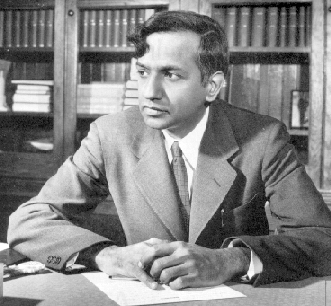
Not all stars fade away with the same grace. For decades, the work of Subrahmanyan Chandrasekhar has defined the boundary between a quiet retirement and a catastrophic end. When a white dwarf accumulates enough matter to cross the limit that bears his name, it can no longer support itself against gravity. In some cases, this leads to an accretion-induced collapse, a process that serves as an alternative pathway to neutron-star formation.
Recent simulations indicate that the rotation and magnetic field of the progenitor white dwarf play a decisive role in what follows. Rapidly rotating, highly magnetized white dwarfs can drive outflows that contribute to the synthesis of heavy elements, including those associated with the r-process. Unlike the explosive disruption of a supernova, these events offer a more nuanced contribution to the chemical enrichment of the galaxy, producing faint but distinct signatures of trans-iron nuclei.
Echoes in the Void
When a sun-like star finally exhausts its nuclear fuel, it expels its outer layers, creating a planetary nebula. These structures, such as the Helix or the Dumbbell Nebula, are illuminated by the intense ultraviolet light of the dying core. Within the Helix, astronomers have identified thousands of cometary knots—droplet-like condensations that form as fast-moving shells of gas collide with denser, slower material ejected earlier. These objects are a reminder that the death of a star is a violent, creative act.
This feedback extends to the scale of entire clusters. In Westerlund 1, the collective winds of thousands of stars heat the surrounding gas, creating a diffuse X-ray glow that traces the influence of massive stars on their environment. Whether through the formation of intricate nebular structures or the heating of intracluster gas, the final stages of stellar life ensure that the material of the star is returned to the galaxy, ready to be recycled into the next generation of stars and planets.
The death of a star is not an erasure, but a redistribution of matter that seeds the galaxy with the ingredients for future generations.