Stellar Evolution and Final Collapse
The life of a star is not a simple ascent to brilliance and a quiet exit, but a chaotic, messy, and often collaborative process of shedding mass and identity.
Cradles of Carbon
The story of a star begins in the cold, dense silence of a molecular cloud, where gravity slowly assembles a core from the interstellar medium. Recent investigations into protostellar envelopes have shown that the chemical environment of these nurseries is far from uniform. By analyzing the absorption features of carbon monoxide and carbon dioxide ice, researchers have traced the isotope ratios of carbon from the earliest stages of formation. These ratios act as a sensitive ledger, revealing that the chemical conditions within these envelopes vary significantly from one system to the next. This variability suggests that the raw material for future planetary systems is subject to complex fractionation processes even before a star has fully matured. Meanwhile, numerical simulations of these collapsing cores have challenged long-held assumptions about how stars manage their angular momentum. While traditional models struggled to explain how discs could form without being shredded by magnetic fields, modern simulations incorporating non-ideal magnetohydrodynamics demonstrate that discs are a robust feature of star formation. These structures persist regardless of whether magnetic braking is idealized or influenced by the complex, low-ionization physics of the cloud, ensuring that the material surrounding a young star remains available for the slow assembly of planets.
The chemical signature of a star is written in the ice of its cradle long before the furnace ignites.
The Turbulent Surface
As a star enters its main sequence, its evolution is dictated by its mass and the efficiency with which it sheds its outer layers. For massive stars, this mass loss is a critical, high-stakes process that determines the nature of their eventual death. Observations of O-type stars in the Small Magellanic Cloud reveal that the wind structure of these giants is not a smooth, steady stream but is instead riddled with small-scale inhomogeneities known as wind clumping. The relationship between this mass loss and the star's metal content is complex; at lower luminosities, the rate of loss scales steeply with metallicity, adding a layer of unpredictability to the life cycles of the most massive objects in the galaxy.
This turbulence is not confined to the young and massive. Betelgeuse, an aging red supergiant, provides a rare, high-resolution look at the chaotic inner atmosphere of an evolved star. Sub-millimeter imaging shows a surface defined by persistent hot patches and deviations from radial symmetry, likely driven by massive, underlying convective cells. These features are surprisingly stable over years, suggesting that the star's outer layers are not merely drifting away but are being actively sculpted by deep-seated motions. Such activity serves as the final, frantic preparation for a supernova, a process that remains difficult to predict despite our ability to observe these giants in exquisite detail.
The Geometry of Departure
When a sun-like star exhausts its nuclear fuel, it does not vanish; it transforms into a planetary nebula, a glowing shroud of expelled gas. This process is rarely a solitary act. Hydrodynamical simulations of asymptotic giant branch stars indicate that the presence of a companion significantly alters the morphology of the outflow. When atomic cooling is accounted for, the interaction between the star's wind and its companion becomes a driver for the formation of flared, sub-Keplerian accretion discs. These discs act as a bridge, channeling material and creating the complex, bipolar structures that characterize many nebulae.
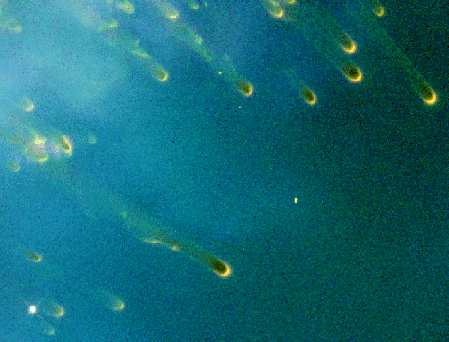
This dispersal can produce unexpected results, such as the cometary knots found in the Helix Nebula. These droplet-like condensations, formed by the collision of fast-moving gas shells with slower, denser material, represent a strange, final act of creation. Spanning billions of miles, these knots suggest that a dying star may leave behind more than just a white dwarf; it may seed the surrounding space with dense, icy bodies that persist long after the central star has faded. The Dumbbell Nebula serves as another testament to this phase, where the intense ultraviolet light of a dying core illuminates the debris of a life once lived, turning the star's final breath into a visible, symmetric monument.
Death is not a clean departure, but a slow, messy dispersal of matter into the void.
The Remnant Archive
The end of a star is also the beginning of an archaeological record. By tracking the kinematics of metal-poor red giants in the galactic halo, astronomers can map the history of the Milky Way itself. These stars, identified through photometric surveys and confirmed by spectroscopy, act as tracers for ancient accretion events, revealing the retrograde mergers and streams that built the galaxy. Each star is a relic, its composition and orbit providing a glimpse into the conditions of the early universe.
Even the most compact remnants—neutron stars and white dwarfs—carry the history of their origins. The natal kicks received by neutron stars during supernovae are encoded in the orbits of their binary systems. While some systems require powerful, asymmetric kicks to explain their current configurations, others, particularly those with high-mass companions, suggest a more restrained birth. Meanwhile, the discovery of short-period blue compact binaries continues to challenge our classification systems. Whether these objects are binary systems or simply rotating, chemically inhomogeneous white dwarfs, they represent the final, enigmatic states of stellar evolution, forcing us to constantly refine our understanding of what happens when the light finally goes out.