Stellar Deaths and Final Galactic Echoes
From the shedding of gaseous veils to the sudden, violent shifts of dying cores, the final acts of stars are far more chaotic than they appear.
The Ghostly Remnants of Light
Stellar life is often framed as a steady, predictable progression, yet the late stages of a star’s existence are defined by profound instability. As stars like our Sun exhaust their nuclear fuel, they shed their outer layers, creating expansive, glowing clouds of gas known as planetary nebulae. These structures, such as the Dumbbell Nebula, are not planets at all, but the luminous debris of a dying core. The intense ultraviolet radiation from the exposed remnant excites the surrounding atoms, forcing them to glow in a final, brilliant display that persists long after the star has ceased its primary work.
The late stages of a star’s existence are defined by profound instability.
Knots in the Expanding Veil
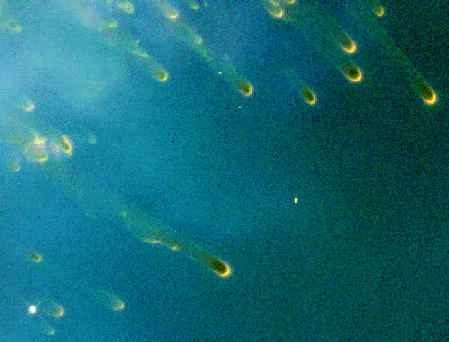
The process of shedding mass is rarely a clean or uniform affair. In the Helix Nebula, astronomers have identified thousands of cometary knots—dense, droplet-like condensations that stretch across billions of miles. These features likely emerge when fast-moving shells of gas overtake slower, denser material ejected during earlier phases of the star's expansion. This collision fragments the outflow, creating a complex, textured landscape. Some researchers speculate that these knots might eventually collapse into icy, planet-like bodies, suggesting that the death of a star could be a nursery for new, albeit frozen, worlds.
Binary Influence and Accretion
When a dying star is not alone, the presence of a companion fundamentally alters its final act. Simulations of asymptotic giant branch stars indicate that binary partners act as gravitational anchors, shaping the outflow into intricate, often bipolar structures. The inclusion of atomic cooling in these models is crucial; it lowers the temperature of the surrounding medium, which in turn facilitates the formation of flared accretion disks around the companion. These disks, reaching sub-Keplerian velocities, capture a significant portion of the stellar wind, proving that the death of one star can provide the fuel for the growth of another.
The death of one star can provide the fuel for the growth of another.
The Stuttering Pulse of the Remnant
Even after the star has collapsed into a dense remnant, the internal dynamics remain volatile. Pulsars, the rapidly spinning, highly magnetized cores left behind by massive stars, are known for their rotational glitches—sudden, unexpected increases in spin frequency. These events, observed even in stars once thought to be quiet, are best explained by the movement of superfluid material within the star’s inner crust. As the superfluid vortices creep through the lattice of the crust, they occasionally unpin and release energy, causing the star to stutter in its rotation. This internal friction provides a rare window into the extreme physics governing the densest objects in the universe.
Defying the Standard Script
While the end of a star is often a slow decline, some stars defy the conventional script with dramatic outbursts. V838 Monocerotis, for instance, underwent a transformation that saw it shift from a modest, warm star to a cool, luminous supergiant in mere months. The nebula surrounding it is not a traditional ejection but a light echo, reflecting the star's past outbursts off previously unseen material. Similarly, the red supergiant Betelgeuse demonstrates that even well-understood stars can exhibit unpredictable dimming, a reminder that the final stages of stellar evolution remain a complex, often mysterious, performance.