Smudges, Rings, and Ripples
The history of astronomy is a catalogue of misnomers, where the most luminous objects in the sky were once dismissed as mere obstacles to discovery.
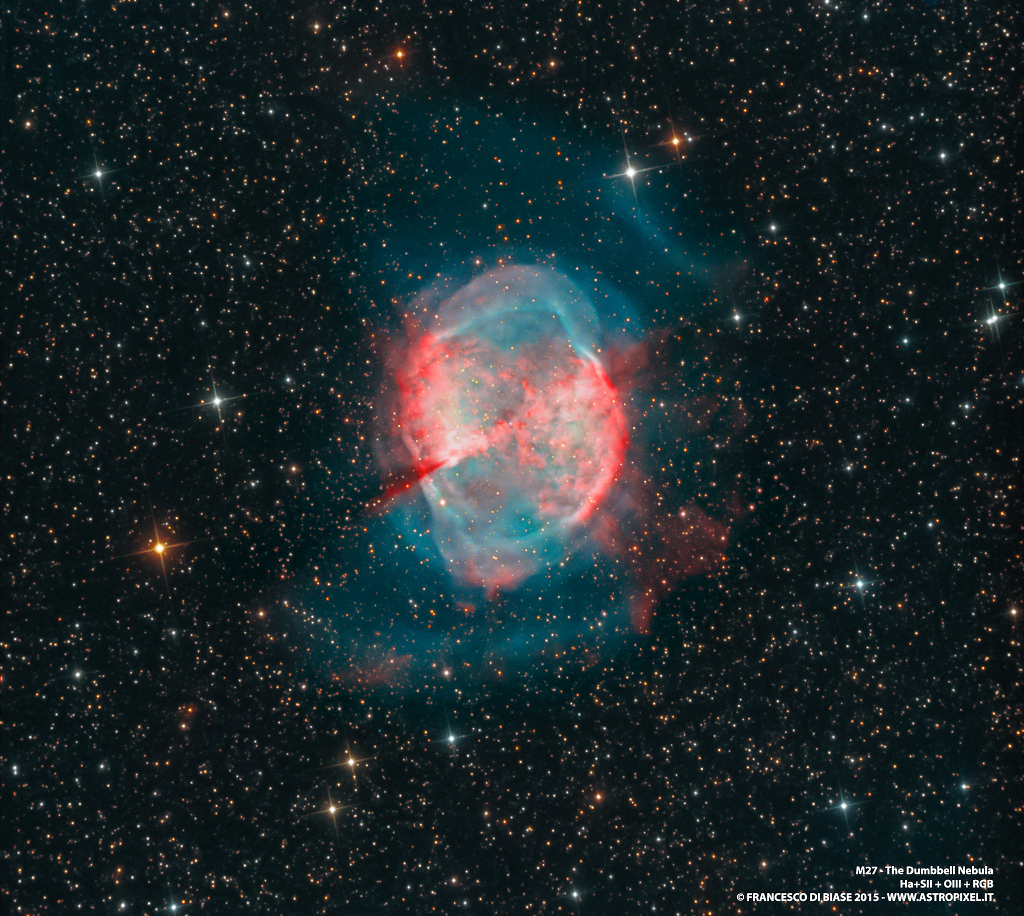
The Catalogue of Errors
In the 18th century, Charles Messier was not looking for the sublime; he was looking for comets. As a diligent hunter of the transient, he maintained a list of fixed objects that threatened to distract him from his quarry. Number 27 on this list, now known as the Dumbbell Nebula, serves as a reminder of how little we once understood the nature of the heavens. To Messier, it was simply a nuisance, a fuzzy smudge that refused to move like a comet. Today, we recognize it as a planetary nebula, a term that remains stubbornly inaccurate. Despite the name, these objects have no connection to planets. They are the final, glowing exhalations of sun-like stars that have exhausted their nuclear fuel, casting their outer layers into the void.
The history of astronomy is a catalogue of misnomers, where the most luminous objects in the sky were once dismissed as mere obstacles to discovery.
The Geometry of Dying Stars
The appearance of these nebulae often tells us more about our own vantage point than the physical reality of the gas clouds themselves. The Ring Nebula, or M57, is a prime example. While it presents as a distinct, barrel-shaped band of light, its form is largely a trick of perspective. We are looking directly down the throat of an expanding shroud of ionized gas. The characteristic colors—the red of ionized hydrogen and the greenish hue of ionized oxygen—are the result of the dying star at the center bombarding its own discarded material with intense ultraviolet radiation. These structures are not static; they are vast, expanding shells, some stretching over two light-years across, marking the quiet, luminous end of a stellar life.
The Violence of Remnants
Not all nebulae are the gentle ghosts of sun-like stars. The Veil Nebula, also known as the Cygnus Loop, is the violent aftermath of a supernova. When a massive star reaches its end, it does not merely exhale; it detonates. The resulting shock wave, which reached Earth’s vicinity thousands of years ago, continues to plow through the interstellar medium at high speeds. This interaction creates the delicate, filamentary structures we observe today. Seen edge-on, these ripples of shocked gas are separated into distinct atomic signatures, with hydrogen glowing red and oxygen providing a sharp blue-green contrast. It is a cataclysm frozen in time, spanning over 70 light-years of space.
The glowing filaments are really more like long ripples in a sheet seen almost edge on.
The Alchemy of Dust and Light
In the Rho Ophiuchi clouds, we see the nebular process from a different angle: the birth of stars rather than their death. These clouds are a complex laboratory of physics. The blue regions are illuminated by the simple reflection of starlight, a process identical to why our own daytime sky appears blue. The red and yellow sections, by contrast, are powered by emission; energetic stars strip electrons from gas atoms, which then release light as they recombine. Interspersed among these glowing gases are dark, opaque regions of dust—the very material from which new stars are forged. This dust effectively blocks the light from behind, creating a silhouette that reveals the density of the cloud. It is a reminder that nebulae are not merely decorative; they are the recycling centers of the galaxy, where the remnants of the past become the raw material for the future.