Standard Model Persistence in Modern Cosmology
Modern cosmology remains remarkably resilient, even as our tools for testing its boundaries grow ever more precise.
The View from the Horn
In the mid-1960s, the search for the remnant radiation of a hot, dense origin was a race between theory and serendipity. While researchers at Princeton were constructing a Dicke radiometer—a device designed to isolate the faint microwave signal of the early universe by switching between the sky and a cold reference—the discovery was ultimately claimed by Penzias and Wilson at Bell Labs. This cosmic microwave background (CMB) provided the first tangible evidence for a hot big bang, grounding a field that had previously relied on indirect clues, such as the spectroscopic behavior of cyanogen in stellar atmospheres. It transformed cosmology from a speculative pursuit into a rigorous, data-driven discipline.
The cosmic microwave background transformed cosmology from a speculative pursuit into a rigorous, data-driven discipline.
Refining the Baseline
Decades later, the standard cosmological model, known as ΛCDM, remains the bedrock of our understanding. Recent measurements from the Atacama Cosmology Telescope, combined with data from the Planck mission and baryon acoustic oscillation surveys, have subjected this model to intense scrutiny. The results are consistent with a universe governed by a cosmological constant, where dark matter is largely collisionless and neutrino properties align with standard predictions. Despite the introduction of various extensions—such as models invoking early dark energy or primordial magnetic fields—the data show no statistically significant departure from the baseline. The universe, it seems, is stubbornly standard.
The Mechanics of Galaxy Growth
While the large-scale structure of the universe appears settled, the evolution of individual galaxies remains a complex interplay of accretion and feedback. Observations from the James Webb Space Telescope have allowed researchers to map the mass-metallicity relation in galaxies as far back as redshift ten. By comparing these observations with high-resolution simulations, astronomers have identified that the chemical enrichment of the interstellar medium is highly sensitive to the stochastic nature of star formation. If star formation flickers too violently, the observed relationship between stellar mass and gas metallicity would dissolve into chaos. Instead, the data suggest a regulated process where supernova-driven outflows and gas accretion maintain a delicate, observable balance.
The chemical enrichment of the interstellar medium is a delicate balance, easily undone by the chaotic flickering of star formation.
Dark Sectors and Anisotropy
The dark sector—comprising dark energy and dark matter—remains the most significant unknown in our inventory of the cosmos. New nonparametric frameworks are now being used to break the degeneracy between a time-varying dark energy equation of state and potential interactions within the dark sector. By reconstructing expansion and growth histories without assuming a rigid parametric form, researchers continue to find that the data remain consistent with the ΛCDM limit. Simultaneously, theoretical work on anisotropic spacetimes has extended the separate-universe picture, providing a way to compute curvature perturbations in backgrounds where rotational symmetry is broken. These tools allow us to test whether the early universe held hidden signatures of complexity that have yet to be resolved by our current observations.
The Search for the Unseen
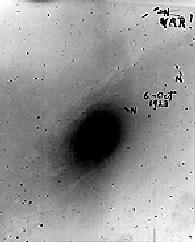
Our map of the universe is still incomplete. While we know that a significant portion of normal matter resides in hot, intergalactic gas filaments, the composition of dark matter and the nature of dark energy remain elusive. Future gravitational-wave observatories like LISA may offer a new path forward by detecting the subtle, stochastic diffractive lensing caused by low-mass dark matter halos. By stacking the signals from multiple binary mergers, we might finally confirm the presence of these elusive structures. From Edwin Hubble’s realization that the Andromeda Nebula was a galaxy unto itself to our modern search for the dark timbre of the cosmos, the history of cosmology is a record of our expanding ability to see what was once hidden.