Cosmic Precision in a Measured Void
A century of refinement has turned our view of the universe from a collection of distant nebulae into a precise, if still mysterious, accounting of energy and matter.
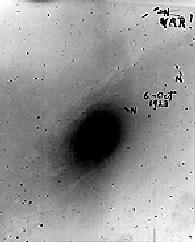
From Nebulae to Standard Candles
In the 1920s, the scale of the cosmos was a matter of intense debate. Edwin Hubble, working with the 100-inch telescope at Mount Wilson, shifted the paradigm by identifying a single variable star in the Andromeda Nebula. By applying Henrietta Leavitt’s work on Cepheid variables—stars that pulse with a predictable rhythm—Hubble could calculate the distance to Andromeda. His discovery that the nebula lay far beyond the bounds of our own galaxy transformed the Milky Way from the entirety of existence into merely one island in a vast, populated sea. This pivot from a static, singular system to an expansive, energetic universe remains the foundational moment of modern cosmology.
The universe grew from a single island into a vast, populated sea.
The Echo of the Beginning
The search for the origin of this expansive system led researchers to look for the thermal remnants of the Big Bang. In the 1960s, Princeton physicists developed the Dicke radiometer, an instrument designed to detect the faint microwave background radiation predicted by hot-universe models. Though Penzias and Wilson at Bell Labs were the first to confirm this signal, the Princeton effort underscored a shift toward rigorous, instrument-driven verification. Today, experiments like the Atacama Cosmology Telescope continue this work, refining our understanding of the cosmic microwave background to test the limits of the standard model, ΛCDM.
Standardizing the Dark
As our reach extends to the earliest epochs, we rely on standard candles—like Type Ia supernovae—to map the expansion of the universe. Recent data from the Zwicky Transient Facility has revealed that these markers are more complex than once assumed. We now know that the luminosity of a supernova is tied to its environment, with host galaxy mass and local color influencing the light curve in ways that require non-linear corrections. This level of scrutiny is necessary because, at these distances, systematic uncertainties have begun to outweigh statistical ones, complicating our efforts to measure the dark energy that drives the late-time acceleration of the cosmos.
This complexity extends to the dark sector itself. Researchers are now using nonparametric frameworks to disentangle the dark energy equation of state from potential interactions between dark matter and dark energy. By analyzing data from multiple sources—including baryon acoustic oscillations and cosmic chronometers—we have found no statistically significant evidence for deviations from the standard model, suggesting that our current, simplified picture of dark energy remains remarkably resilient.
Refining the tools of measurement has revealed that the universe is not just distant, but deeply sensitive to its own history.
Anisotropy and the Limits of Theory
While the standard model holds, theorists are testing its boundaries by exploring anisotropic spacetimes. New work on the separate-universe picture shows that curvature perturbations in an anisotropic background are richer than those in isotropic models, involving conserved channels linked to scalar fields and background shear. These frameworks allow us to predict statistical anisotropies in the primordial power spectrum, providing a way to bridge the gap between early-universe physics and observable gravitational waves.
Even as we map the largest scales, we look for the smallest. Gravitational wave observatories like LISA may eventually detect the influence of low-mass dark matter halos through stochastic diffractive lensing. By analyzing the 'dark timbre' imprinted on gravitational wave signals, we may finally characterize the nature of dark matter on scales that have remained hidden from traditional electromagnetic observation.
The Observer's Burden
As our cosmological models grow more precise, the philosophical implications of our observations become harder to ignore. The measure problem asks how we should account for observers within a vast, potentially infinite, or multi-faceted universe. It is not enough to simply count occurrences; we must distinguish between the physical history of the universe and the subjective experience of the observer. Whether we are discussing the typicality of an observer or the probability of a specific event, the challenge lies in defining a framework that does not rely on a global sampler—a task that requires us to treat probability and self-location as distinct, type-theoretically separate concerns.
This rigor is the hallmark of modern cosmology. From the early, uncertain plates of the 1920s to the high-precision data of the 2020s, the field has moved from discovery to a state of forensic accounting. We are no longer just looking at the sky; we are interrogating the very definitions of the laws that govern it, ensuring that our models of the dark sector, the early universe, and the observer remain internally consistent.