Cosmic Expansion and the Filamentary Web
From the first realization of galactic distance to the complex simulations of dark matter, our understanding of the universe is a slow, methodical process of refining the boundaries of the known.
A Century of Measured Distance
In the 1920s, Edwin Hubble peered at photographic plates from the Mt. Wilson Observatory, searching for novae in the Andromeda Nebula. His process was painstaking, relying on the work of Henrietta Leavitt, who had established that certain pulsating stars, or Cepheids, acted as reliable standard candles. By identifying one such star, Hubble crossed out his initial notation of a nova and replaced it with a definitive Var! for variable. This simple correction fundamentally altered our perspective, proving that Andromeda was not merely a cluster of gas within our own galaxy, but a vast, independent entity. It was the birth of the modern concept of a universe populated by countless galaxies, a leap that moved us from a local view to a cosmic one.
The Persistent Silence of the Standard Model
Modern cosmology remains anchored to the ΛCDM model, a framework that has proven remarkably resilient even under the scrutiny of increasingly precise instruments. Data from the Atacama Cosmology Telescope, combined with legacy measurements from the Planck mission and baryon acoustic oscillation surveys, show no statistically significant departure from this baseline. We find that neutrino properties align with Standard Model predictions, and there is no evidence for new, light, free-streaming species or self-interacting dark radiation. The fundamental constants, such as the fine-structure constant and the electron mass, appear stable across cosmic time, reinforcing the validity of general relativity in describing the growth of structure. When researchers test for early dark energy or modified recombination histories, the results consistently return to the standard range of expansion values, suggesting that our foundational assumptions about the early universe are robust.
The universe appears to be a consistent, if stubbornly mysterious, machine that refuses to reveal new physics through the current resolution of our instruments.
Shadows in the Filamentary Web
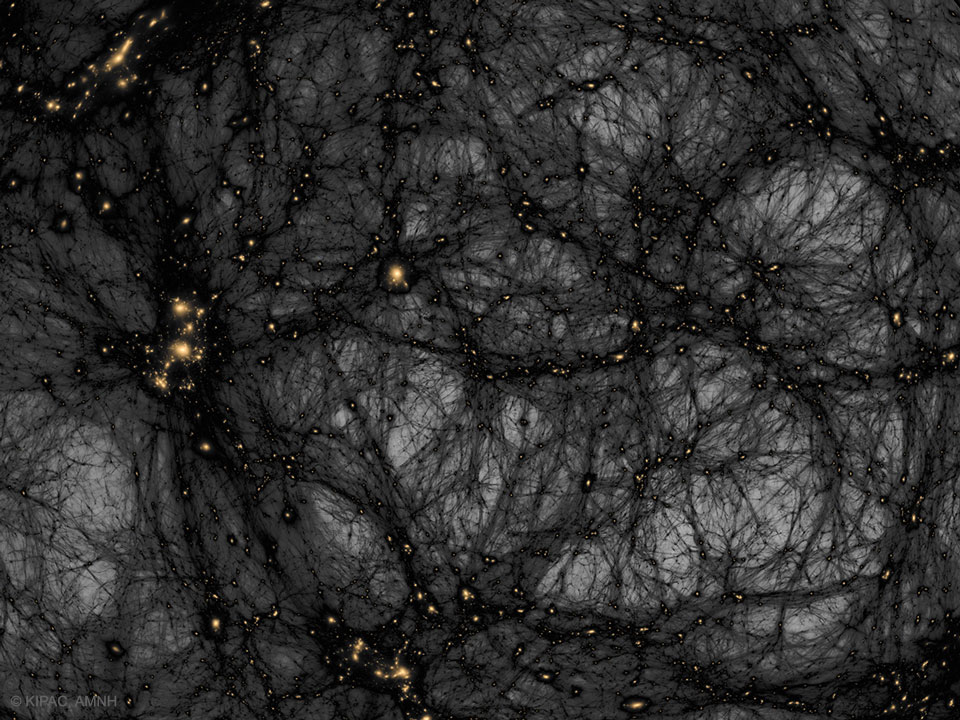
While the visible universe is composed of stars and galaxies, these represent only a fraction of the total matter. Observations from the Chandra X-ray Observatory have confirmed that much of the normal, baryonic matter resides in hot gas filaments stretching between galaxies. These filaments mirror the distribution of dark matter, a pervasive, invisible substance that acts as the scaffolding for the cosmos. Simulations of this dark web show complex, spider-web-like structures that match the statistical distribution of galaxies we observe. Yet, dark matter is no longer the most enigmatic player in the cosmic drama; that title now belongs to dark energy, a uniform, repulsive force that drives the accelerated expansion of the universe.
The Search for Dynamical Signatures
Despite the success of the standard model, researchers continue to probe for hints of dynamical dark energy. Recent analyses using methods like Weighted Function Regression have sought to move beyond the arbitrary truncations of previous models, allowing the data to dictate the evolution of the dark energy equation of state. Some studies suggest a transition from phantom to quintessence behavior at specific redshifts, though these findings often remain sensitive to the choice of supernova datasets. Simultaneously, new frameworks are being developed to distinguish between genuine dark energy dynamics and potential interactions within the dark sector. By reconstructing expansion and growth histories without assuming a fixed form, scientists hope to determine whether the apparent complexity in our data is a physical reality or merely an artifact of our mathematical approximations.
We are currently in a phase of cosmic accounting where the distinction between a genuine physical anomaly and a statistical shadow remains the primary challenge.
The Observer and the Infinite
As our reach extends to the edges of the observable, we encounter the measure problem: how to define the probability of typicality for an observer in an infinite universe. This is not merely a question of data, but of theoretical architecture. Distinguishing between dynamical transition probabilities, Born weights, and self-locating credence requires an explicit interpretive bridge. Without a global sampler, we must specify how to weigh observer-moments and lineages within a decoherent-history framework. This is the frontier of cosmology where the physical laws of the universe meet the epistemic limitations of the observer, reminding us that our understanding of the cosmos is inextricably linked to our place within it.