Limits and Landscapes
From the collapse of stars to the expansion of the universe, modern astrophysics relies on the relentless refinement of mathematical models and observational precision.
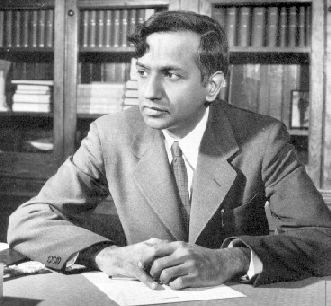
The Calculus of Collapse
The history of modern astrophysics is often told through the lens of limits. When Subrahmanyan Chandrasekhar calculated the maximum mass a white dwarf could sustain before succumbing to gravitational collapse, he did more than define a boundary for stellar death; he established a rigorous mathematical framework for the life cycles of the most extreme objects in the universe. Today, this tradition of precision continues as researchers refine our understanding of how gravity, mass, and energy interact across scales ranging from the microscopic density of a neutron star to the expansion of the cosmos itself.
The history of modern astrophysics is often told through the lens of limits.
Oscillations in the Extreme
At the scale of individual stellar remnants, the complexity of matter remains a primary challenge. Recent studies of neutron stars have moved beyond simple isotropic models, incorporating anisotropy to better understand how internal pressure affects stellar stability. By analyzing f-mode oscillations, researchers have found that the relationship between mass, density, and frequency is sensitive to the internal equation of state. These oscillations act as a diagnostic tool, revealing how the stiffness of matter within a neutron star influences its structural integrity and its eventual cooling or damping over time.
Standardizing the Transient
On a larger scale, the quest to map the universe requires standardizable candles that can reach across vast distances. Gamma-Ray Bursts (GRBs) have long been candidates for this role, yet their inherent variability has historically complicated their use as distance indicators. By employing new, model-independent calibration methods—such as the Dainotti correlation—astrophysicists are now able to isolate specific sub-samples of these energetic transients. This allows for a more reliable extension of the cosmic distance ladder, providing a clearer view of the universe at redshifts where traditional markers like Type Ia supernovae become scarce.
Astrophysicists are now able to isolate specific sub-samples of these energetic transients to extend the cosmic distance ladder.
Probing the Cluster Core
The search for structure extends to the centers of globular clusters, where the presence of intermediate-mass black holes has been a subject of intense scrutiny. By combining stellar kinematics with the precise timing of millisecond pulsars, researchers have developed more nuanced mass models for clusters like Omega Centauri. These findings suggest that the central mass is often more extended than previously assumed, favoring models of stellar encounters over the presence of a singular, massive black hole. This methodology highlights the power of multi-messenger data in resolving long-standing debates about the dense hearts of star clusters.
Testing the Cosmic Fabric
Even as we refine our local models, the broader cosmological framework remains under constant test. Recent data from the Dark Energy Spectroscopic Instrument (DESI) has provided new constraints on modified gravity, consistently aligning with the predictions of general relativity. While the allure of finding deviations from standard models persists, current observations suggest that the fundamental laws governing the expansion of the universe are remarkably robust. This consistency does not stifle inquiry; rather, it sets a precise baseline against which future anomalies in dark energy or cosmic acceleration can be measured.
The Dynamics of Feedback
From the convective cells on the surface of Betelgeuse to the diffuse X-ray emission in supermassive star clusters like Westerlund 1, the field is defined by an ongoing effort to reconcile theoretical predictions with high-resolution observation. Whether through mapping the propagation of coronal mass ejections or characterizing the dense, cold gas in infrared dark clouds, the focus remains on the interplay between feedback, evolution, and the environment. These efforts collectively illuminate the mechanisms that drive the formation of stars and the subsequent enrichment of the interstellar medium, ensuring that our view of the cosmos remains as dynamic as the objects within it.