Invisible Matter: Measuring the Cosmic Unknown
From the densest stellar cores to the dark matter shaping galaxy clusters, modern astrophysics is a study in how we measure what we cannot directly see.
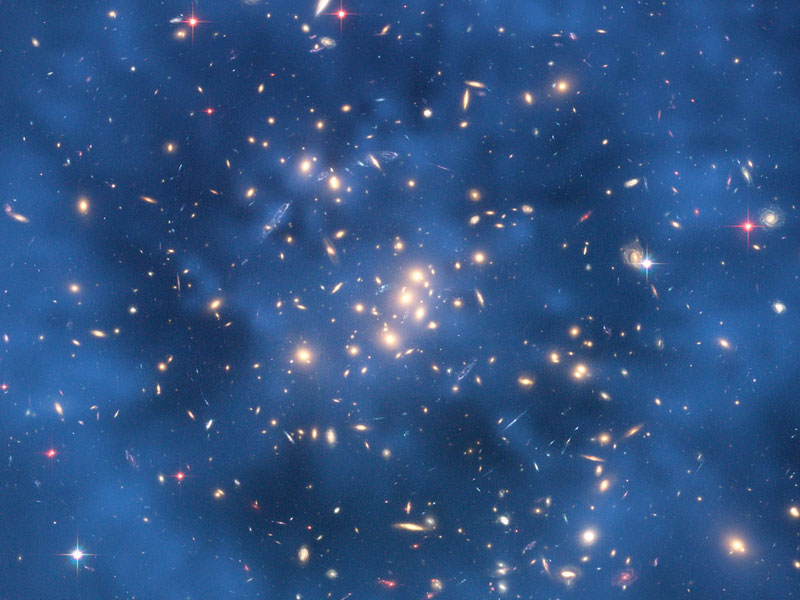
Shadows in the Light
The history of astronomy is, in many ways, a history of inferring the unseen. Long before we could resolve the physical structure of distant objects, we relied on the gravitational tugs they exerted on their neighbors. Sirius B, the closest known white dwarf, was detected not by its own faint light, but by the way its gravity perturbed the path of the brilliant Sirius A. This method remains a cornerstone of the field, whether we are mapping the distribution of dark matter around galaxy clusters like CL0024+17 or weighing the extreme density of a pulsar.
We are learning to map the universe by the ripples left in the wake of things we cannot see.
The Limits of Matter
When we look at objects like the pulsar PSR J1614–2230, we are peering into a laboratory of extreme physics. By timing the arrival of pulses as the star passes behind its white dwarf companion, astronomers can measure the Shapiro delay—a relativistic effect that reveals the pulsar's mass with startling precision. At nearly two solar masses, this object forces us to discard theoretical models that suggest neutron stars might be composed of exotic matter like kaon condensates. If such matter existed in the core, the star would have collapsed into a black hole long before reaching such a weight.
The Chemistry of Formation
While pulsars test the limits of gravity, other instruments are probing the chemical origins of planets. Using the James Webb Space Telescope, researchers have begun to inventory the ice distribution in protoplanetary disks, identifying water, carbon dioxide, and ammonia. These volatile reservoirs are the building blocks of planetary atmospheres, and their location within a disk—often far above the midplane—tells us how water might eventually be delivered to terrestrial worlds. In some systems, the sublimation of these ices creates gas disks that could turn inner planets into vast, water-rich worlds.
Standardizing the Cosmic Yardstick
Cosmology relies on our ability to use Type Ia supernovae as standard candles to measure the expansion of the universe. However, recent data from the Zwicky Transient Facility suggests that our yardstick is more complex than once thought. The relationship between a supernova's light-curve width and its intrinsic luminosity is not a single, linear rule; it shifts depending on the environment and the stellar mass of the host galaxy. Failing to account for these environmental biases could introduce significant errors into our understanding of the late-time expansion history of the cosmos.
Our cosmic yardsticks are not as uniform as we once assumed, and the environment of a star changes the way it dies.
The Persistence of the Standard Model
Despite these granular complexities, the foundational framework of the universe—the ΛCDM model—remains remarkably resilient. Recent measurements from the Atacama Cosmology Telescope, combined with data from other missions, show no statistically significant departure from this baseline. Whether testing neutrino properties, the fine-structure constant, or the growth rate of structure, the data consistently point back to a model that, while perhaps incomplete, remains the most robust description of our universe's evolution. Even as we find new phenomena like the radio rebrightening of changing-look active galactic nuclei, the broader picture of a dark-energy-dominated cosmos holds firm.