Cosmic Data Shaping Our Stellar View
From the rhythmic pulses of distant stars to the chemical signatures of newborn planetary systems, our view of the cosmos is undergoing a quiet, data-driven transformation.
The Persistent Pulse of the Main Sequence
For years, the Gaia mission has surveyed the heavens, capturing the faint, irregular light curves of hundreds of thousands of variable stars. While these data points were often sparse and subject to millimagnitude-level noise, they served as a foundational catalog for identifying non-radial pulsators. By cross-referencing these observations with the more precise, high-cadence photometry provided by the TESS mission, researchers have been able to refine our understanding of these stellar rhythms. The alignment between the two datasets is striking, with Gaia proving remarkably capable of identifying the dominant and secondary frequencies that define these stars. This synergy has confirmed that g-mode pulsators form a continuous, coherent group across B, A, and F spectral types, suggesting that our current models of mode excitation require a more nuanced physical framework.
The rhythmic flickering of stars provides a quiet, reliable map of the physics governing the main sequence.
Simulating the Breath of a Galaxy
Dwarf galaxies serve as the ultimate laboratory for observing the interplay between stellar feedback and the interstellar medium. Because these systems are small and sensitive, the radiation, winds, and supernovae produced by individual massive stars have a disproportionate impact on their evolution. Traditional numerical models have often relied on simplified approximations to handle the computational burden of radiative transfer. However, new frameworks like RIGEL are changing this by explicitly modeling the radiative feedback on a star-by-star basis. By tracking the thermochemistry of gas from cold molecular clouds to hot ionized states, these simulations demonstrate how stellar birth rapidly disperses the dense fuel required for future star formation. This feedback loop can reduce a galaxy's star formation rate by an order of magnitude, illustrating how the life of a single massive star dictates the lifecycle of its host.
Chemistry in the Cradle
The earliest stages of star formation remain shrouded in dust, yet they are the most critical moments for defining the future of planetary systems. Using the mid-infrared sensitivity of the James Webb Space Telescope, astronomers are now probing these embedded environments on scales as small as thirty astronomical units. By analyzing the spectral lines of atomic and molecular species, researchers can map the complex chemistry of jets, outflows, and disks. These observations reveal how refractory and volatile elements behave under the intense conditions of protostellar shocks, providing a diagnostic tool that was previously inaccessible.
Beyond mapping physical structures, this spectral clarity allows for a precise accounting of isotopes. By measuring the ratios of carbon isotopes within CO and CO2 ice, scientists are tracing the chemical evolution of stellar nurseries. These ratios vary from one protostellar envelope to another, suggesting that the local chemical environment is far more dynamic than once assumed. This data provides a vital link between the chemistry of the natal cloud and the eventual composition of the planets that will emerge from the disk.
The James Webb Space Telescope has turned the opaque nurseries of protostars into transparent chemical ledgers.
The Unpredictable Sky
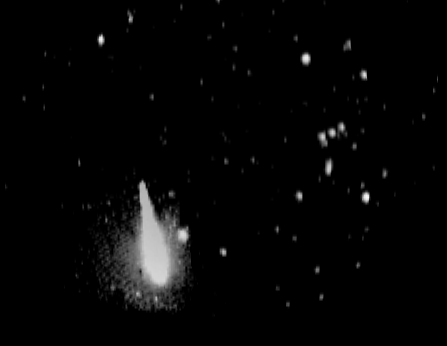
The night sky is often perceived as a static backdrop, yet it is a theater of constant, often violent, change. Fireballs and meteors serve as daily reminders that the solar system is littered with debris, ranging from dust to rocks large enough to threaten regional stability. While the arrival of a comet like Hyakutake once signaled the fall of empires to the superstitious, modern astronomy treats these visitors as predictable, if spectacular, phenomena. Yet, not all events are so orderly; the sudden appearance of a supernova in a nearby galaxy like M51 serves as a stark reminder of the limits of our predictive power. When these transient events occur, they demand the attention of both professional observatories and dedicated amateurs, whose intermittent observations fill the gaps in our understanding of stellar death.
A World Twenty-Two Light-Years Away
The catalog of known exoplanets continues to grow, with recent discoveries like Gl 725 B c demonstrating the diversity of our local neighborhood. Located just over twenty-two light-years away, this planet orbits its host star every thirty-eight days, possessing a mass roughly three times that of Earth. Its discovery, made via the radial-velocity method, highlights the precision with which we can now detect the subtle gravitational tugs of planets on their parent stars. While its equilibrium temperature sits well below freezing, the existence of such a world underscores the ubiquity of planetary systems, even in binary star configurations.